
Why content audits matter more in 2026
A good SEO content audit answers one question: which pages are working, which are dragging the rest of the site down, and what should we do about each one? Get that right and you can double organic traffic from content you already own. Get it wrong and you’ll spend a quarter writing new pieces that compete with your old ones for the same query.
In 2026 the audit looks different than it did even two years ago. AI Overviews intercept clicks. ChatGPT and Perplexity cite some pages and ignore others. Pages that ranked beautifully last year may be quietly leaking share of voice in AI search. Any modern content optimization workflow has to grade every page for SEO, GEO, and AEO – not just the classic SERP.
This guide walks through the whole content audit process, from inventory to action plan, with the framework, scorecard, and tools you can use today.
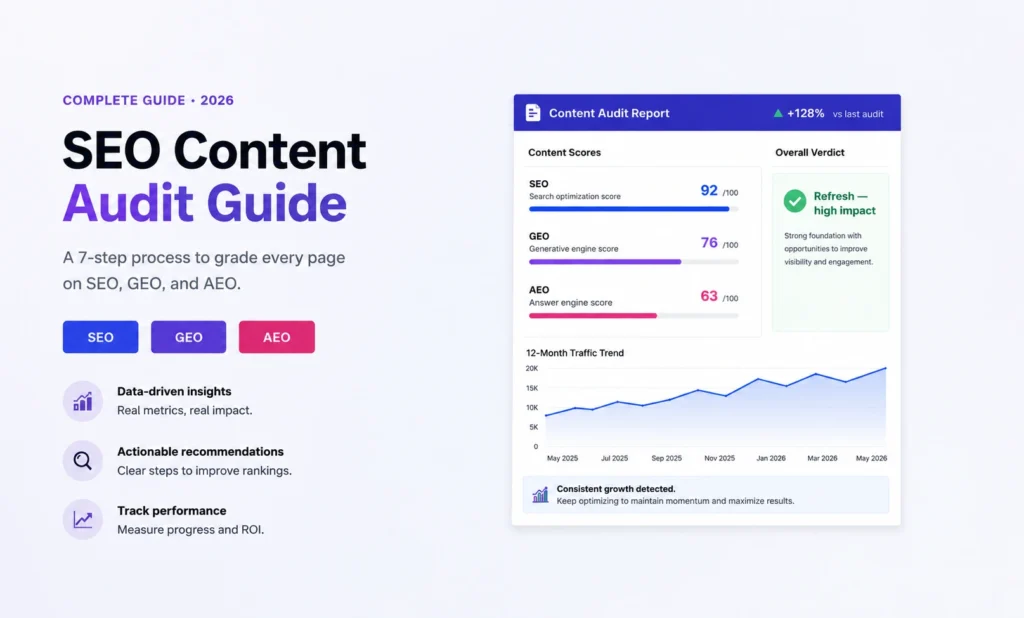
What is an SEO content audit?
An SEO content audit is a systematic review of every indexable page on a site to assess performance, quality, and strategic fit, and to decide what happens next: keep, refresh, consolidate, repurpose, or remove.
A modern content audit grades each page on five quality dimensions:
- Search performance. Clicks, impressions, rankings, and AI search citations.
- Content quality. Depth, accuracy, originality, and topical authority.
- Search-surface fit. Whether the page matches SEO, GEO, and AEO best practices for its target query.
- Brand and editorial fit. Voice, tone, factual grounding, and editorial standards.
- Strategic fit. Whether the page still belongs in your content strategy or has outlived its purpose.
A content audit should produce decisions, not a spreadsheet. If your audit ends with a list and no action plan, you stopped halfway.
When should you run an SEO content audit?
Run a full SEO audit at any of these moments:
- Before a major SEO push or content investment, so you build on what’s already working.
- After a Google algorithm update or sustained traffic drop, to find the casualties.
- On a fixed schedule. Once a year minimum, twice for fast-moving sites.
- Before a site migration or rebrand, to decide what survives and what doesn’t.
- When AI search visibility data shows competitors pulling ahead in your category.
Smaller audits – a single topic cluster or content category – should run continuously throughout the year. The big annual audit is the strategic reset.
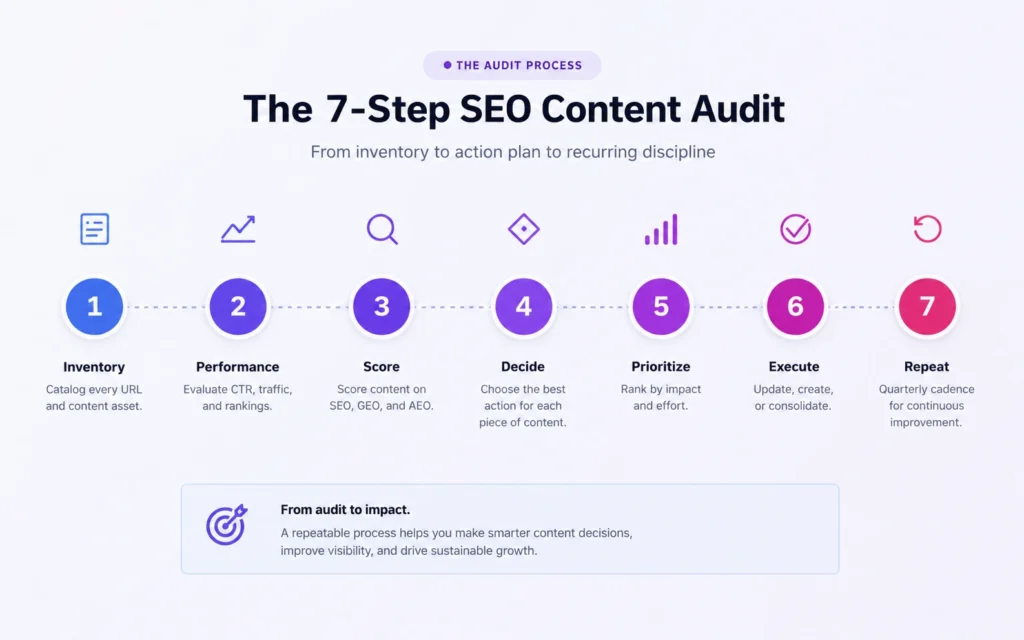
The 7-step SEO content audit process
The content audit process below is the workflow we use inside GazeSEO with mid-market content teams. It scales from a 50-page startup blog to a 5,000-page enterprise site – only the tooling at each step changes.
Step 1: Build the content inventory
Start with a complete list of every URL on the site. Pull it from Google Search Console, your XML sitemap, or a crawler like Screaming Frog or Sitebulb. For each URL, capture:
- URL, title tag, meta description, H1.
- Word count, publish date, last updated date.
- Author and content type (blog post, landing page, pillar page, etc.).
- Primary target keyword.
- Internal link count (in and out).
The inventory is your audit’s spine. Everything else is just a column added to it. If you build content from structured briefs, most of these fields can be populated automatically from your CMS or brief database.
Step 2: Add performance data
Layer in the last 12 months of performance data:
- Clicks and impressions (Google Search Console).
- Average ranking position for the primary keyword.
- Sessions, conversions, and assisted conversions (GA4 or your analytics platform).
- Backlinks (Ahrefs, Semrush, or Moz).
- AI search citations – which AI engines cite this URL, and how often.
That last column is the one most audits are missing. A page that has lost ranking ground but is still being cited by ChatGPT and Perplexity is more valuable than one that ranks #5 and gets ignored by AI search. To make your site easier for those engines to discover and parse, publish a machine-readable index with the llms.txt generator.
Step 3: Score each page for SEO, GEO, and AEO
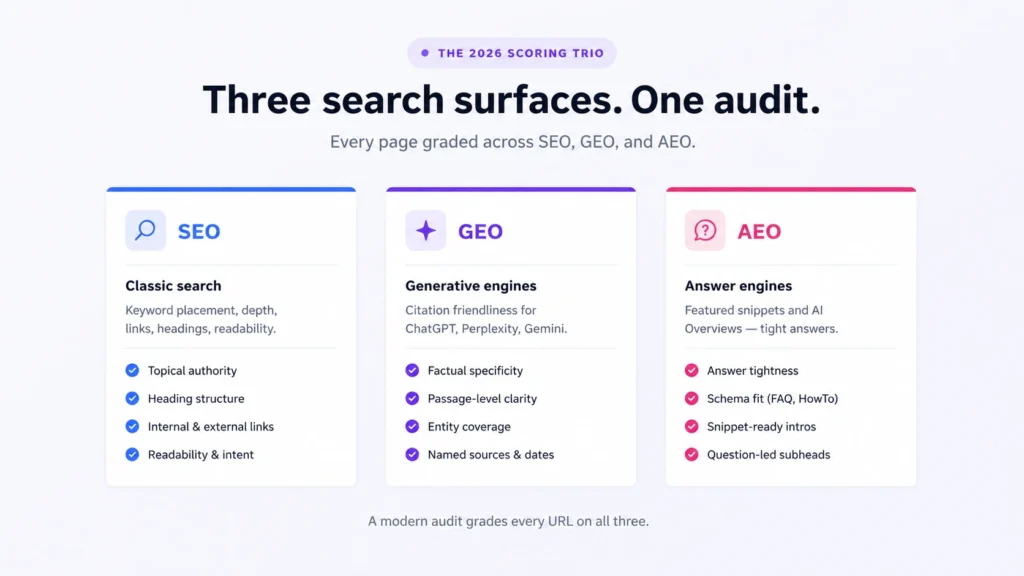
Run each URL through a scoring tool that grades it across all three search realities:
- SEO score – keyword placement, topical depth, heading structure, links, readability.
- GEO score – citation friendliness, factual specificity, passage-level clarity for AI engines.
- AEO score – answer tightness, schema fit, featured-snippet readiness.
The free GazeSEO SEO Score Checker grades all three in seconds. For larger sites, the bulk SEO scoring feature inside the platform can grade a whole list of URLs in one pass and export the scorecard alongside priority fixes.
Step 4: Decide on each page
With performance data and quality scores in hand, every page falls into one of five verdict buckets. This is the heart of any content audit – get it right and the rest of the work mostly executes itself.
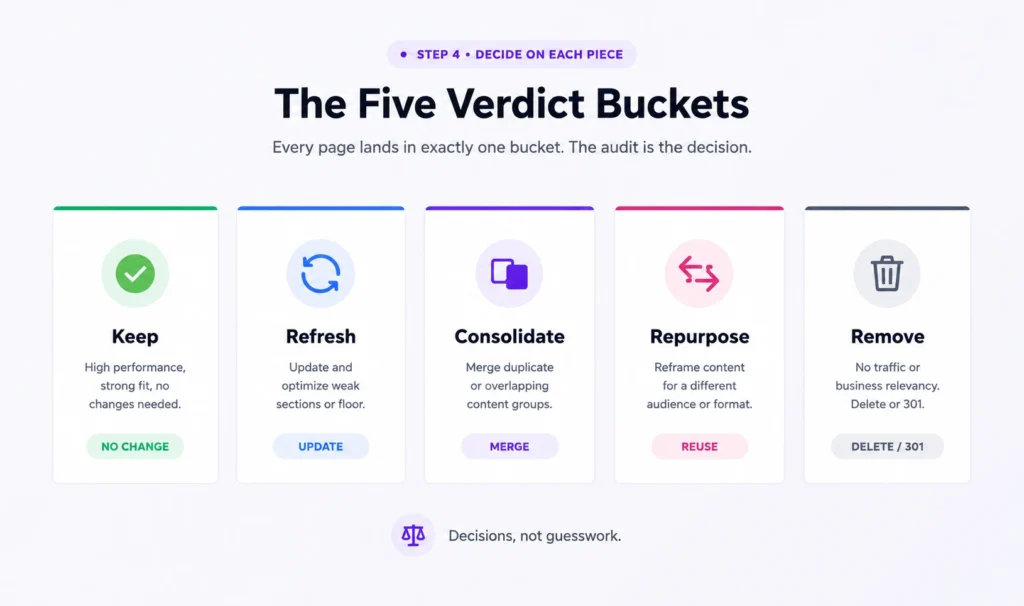
| Verdict | When to apply |
| Keep | Strong performance, high SEO/GEO/AEO scores, on-strategy. Leave it alone – or tweak only if it’s one fix from a big jump. |
| Refresh | Lost performance over time but still on-strategy. Update the content and re-optimize for current search surfaces. |
| Consolidate | Two or more pages compete for the same query. Merge into one canonical, stronger piece and redirect the rest. |
| Repurpose | Quality is fine but the format is wrong. Convert into a new format (listicle, video, FAQ) targeting the same query. |
| Remove | Off-strategy, poor quality, no traffic, no links. Redirect or 410, depending on whether anything else points to it. |
Step 5: Prioritize the action plan
Sort the list by predicted impact. The fastest wins are almost always:
- Pages ranking #4–#15 with weak GEO/AEO scores. A single optimization pass can move them into the top 3 and into AI citations.
- Pages with declining traffic but strong backlinks. Refresh the content – don’t let the link equity rot.
- Multiple thin pages competing for the same query. Consolidate into one stronger piece.
- Pages already cited by AI engines but missing required entities. Add the missing context to win more citations.
- Old pillar pages whose content has aged. Pillars decay slowly, then all at once.
Step 6: Execute and track the change
For every refresh, capture a baseline (current rank, traffic, AI citations) before you change anything. After the update, monitor the same metrics weekly for the first month. If you don’t measure, you can’t tell whether the audit produced anything except busywork.
For teams executing at scale, the AI content agent can run the rewrite pass against your scoring criteria and the AI content writer can draft the new sections – while keeping voice locked to your brand voice profile.
Step 7: Repeat continuously
A content audit isn’t an event – it’s a discipline. Schedule a quarterly review of your top 100 pages and a full annual audit. The teams that compound their organic traffic do this religiously. The teams that plateau skip it.
What a 2026 content audit adds beyond the classic checklist
The classic SEO content audit has been around for 15 years. Here’s what a modern audit needs to add on top of it.
AI search visibility
For every URL, check whether ChatGPT, Perplexity, Gemini, and Claude cite it for the queries you care about. A page that ranks well on Google but is invisible in AI search is half-optimized. Track citations the same way you track rankings – over time, by query, and against named competitors.
GEO score
Score every page for citation friendliness, passage-level clarity, factual specificity, and entity coverage – the patterns generative engines reward. Pages with crisp definitional passages and named entities (people, products, places, dates) get cited; vague pages do not.
AEO score
Score every page for answer tightness and schema fit. AI Overviews and featured snippets are now a primary destination for informational queries, so the first 40–80 words after a question subhead need to answer the question cleanly.
Brand voice consistency
Old AI-generated content drifts off-brand fast. Audit voice consistency alongside SEO performance – especially across content produced by different writers, agencies, or models. A locked brand voice profile applied during the refresh pass is the cleanest way to claw consistency back.
Factual grounding
Check every claim against your current source material. AI search engines penalize stale or unverifiable claims. So do customers. A connected knowledge knowledge base of approved facts, stats, and sources makes this pass orders of magnitude faster.
Free SEO content audit checklist
A short content audit checklist you can run on every page – bookmark, copy into your audit sheet, or paste into your scoring tool:
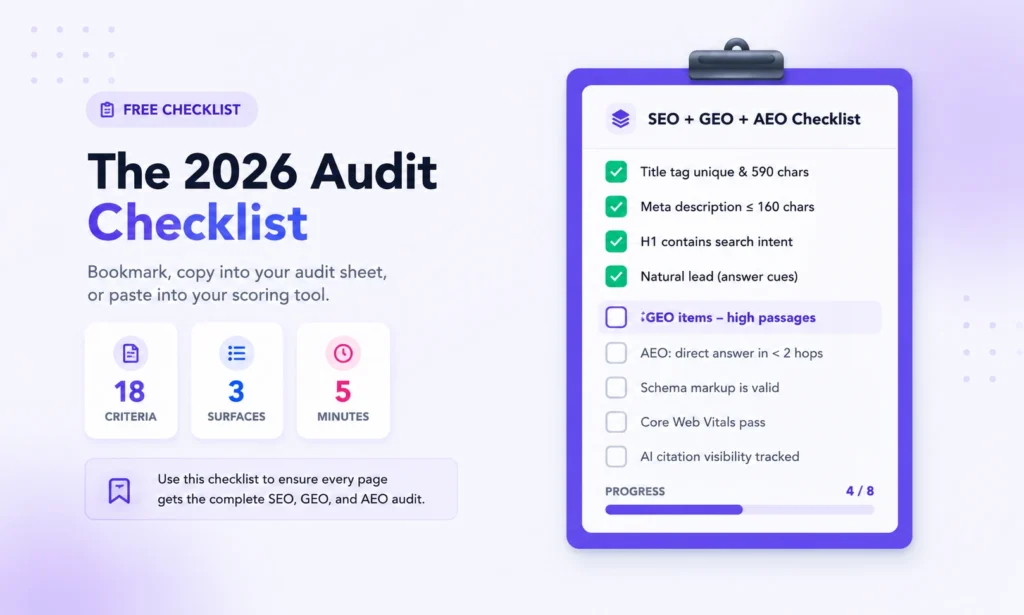
- Title tag is unique, contains the primary keyword, and is ≤60 characters.
- Meta description is unique, contains the primary keyword, and is ≤160 characters.
- H1 matches search intent and is unique on the page.
- Subheads (H2/H3) are descriptive and answer-led for AEO.
- Primary keyword appears in the intro, one H2, and the meta – without stuffing.
- Secondary keywords and entities are covered comprehensively.
- Internal links: 2–3 outbound to related pages; inbound links from at least 3 strong pages.
- External links to 1–2 authoritative sources.
- Word count fits the search intent (informational longer; transactional shorter).
- Schema markup applied where appropriate (FAQ, HowTo, Article).
- Images are optimized, with descriptive alt text.
- Page loads in under 2.5 seconds; Core Web Vitals pass.
- Content has been updated in the last 12 months – or has a clear evergreen reason not to be.
- Brand voice is consistent with current editorial standards.
- Every claim is grounded in a source you can defend.
- GEO score: tight passages, clear answers, citation-friendly structure.
- AEO score: direct answers near the top of relevant sections.
- AI search visibility: page is cited (or competing for citation) on the queries you care about.
Want this as a working content audit template? Score any URL instantly with the free
SEO Score Checker – it outputs the same checklist as a per-page report with prioritized fixes
Common SEO content audit mistakes (and how to avoid them)
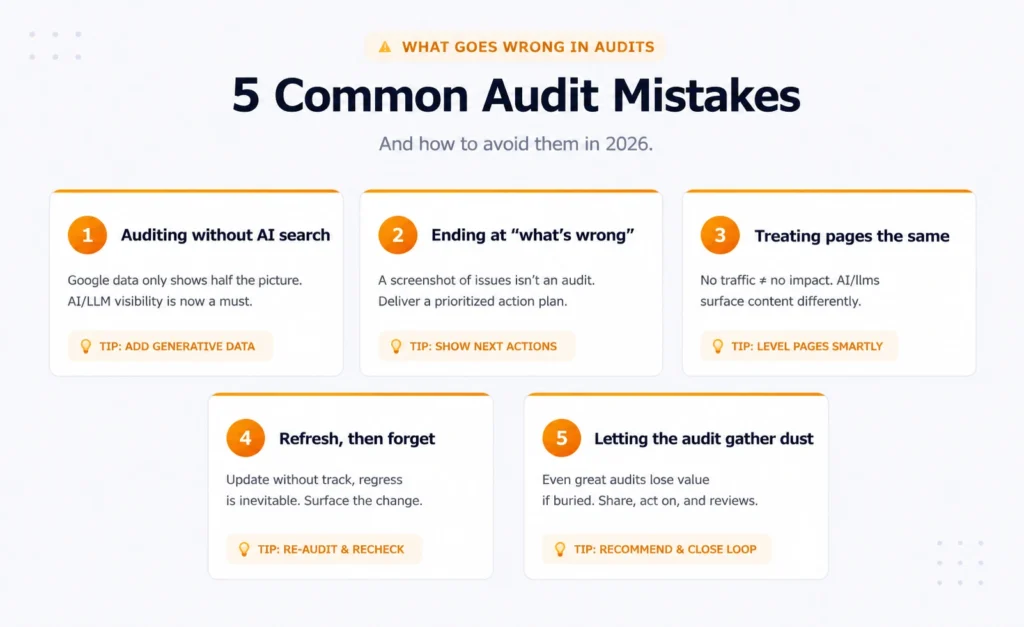
Mistake 1: Auditing in isolation from AI search
A content audit that only looks at Google data misses half the picture in 2026. Always include AI search citation and visibility data for the queries you target.
Mistake 2: Ending the audit at “what’s wrong”
A spreadsheet of issues isn’t an audit. The deliverable is a prioritized action plan with clear owners, deadlines, and expected outcomes.
Mistake 3: Treating every low-performing page the same
A page with no backlinks and no traffic isn’t the same as a page with great backlinks but weak content. The decisions – “remove” vs “refresh” – are different.
Mistake 4: Refreshing without re-promoting
After you update a page, refresh the internal links pointing at it, request reindexing, and consider a small social or newsletter mention. Otherwise the change goes unnoticed.
Mistake 5: Letting the audit gather dust
The audit you ran a year ago is already partly stale. Schedule the next one and assign owners before this one ends.
Frequently asked questions
How long does an SEO content audit take?
A site with under 100 pages can be audited in a week by one person. A 1,000-page site usually needs 2–4 weeks with a small team and a bulk-scoring tool. AI-assisted tools have made a same-week audit realistic for sites up to 500 pages.
What tools do I need to do a content audit?
At minimum: a crawler (Screaming Frog or Sitebulb), Google Search Console, an analytics platform, and a content scoring tool. GazeSEO’s bulk page audit and SEO Score Checker handle the SEO/GEO/AEO scoring; Ahrefs or Semrush handle backlinks; AI visibility checkers add the citation layer.
What’s the most important metric in a content audit?
There isn’t one. The decision framework matters more: combine performance (clicks, impressions, conversions) with quality (SEO + GEO + AEO scores) and strategic fit. Pages that score well on all three are keeps. Pages weak on all three are usually removes.
Should I delete poorly performing pages?
Sometimes. Delete or 301 only if the page is off-strategy, has no backlinks, no traffic, and no signal worth preserving. If it has any of those, refresh or consolidate before deleting.
How does AI search change content audits?
It adds a parallel quality lens. A page that ranks well in Google but is never cited by ChatGPT or Perplexity is leaking visibility. A page that gets cited by AI engines but ranks poorly on Google is undervalued. A modern audit surfaces both.
How often should I run an SEO content audit?
Run a full audit at least once a year, twice for fast-moving sites. Run smaller cluster-level audits continuously throughout the year, and run an unscheduled audit after any major Google update or sustained traffic drop.
Turn the audit into a recurring discipline
The teams that compound organic traffic year after year aren’t the ones writing the most new content. They’re the ones auditing relentlessly – finding the pages one fix away from a win, the duplicates that should be consolidated, and the dead weight that needs to go.
A 2026 audit adds the AI search lens to that discipline. Score every page for SEO, GEO, and AEO. Track citation visibility alongside ranking. Turn every audit into a prioritized action plan, not just a spreadsheet.